阿美特克-博勒飞 适配器 螺旋 - 操作说明
文件名:阿美特克-博勒飞 适配器 螺旋 - 操作说明
格式:PDF
大小:468.05 KB
页数:14页
本站仅提供预览学习使用,请勿用于商业用途
内容介绍
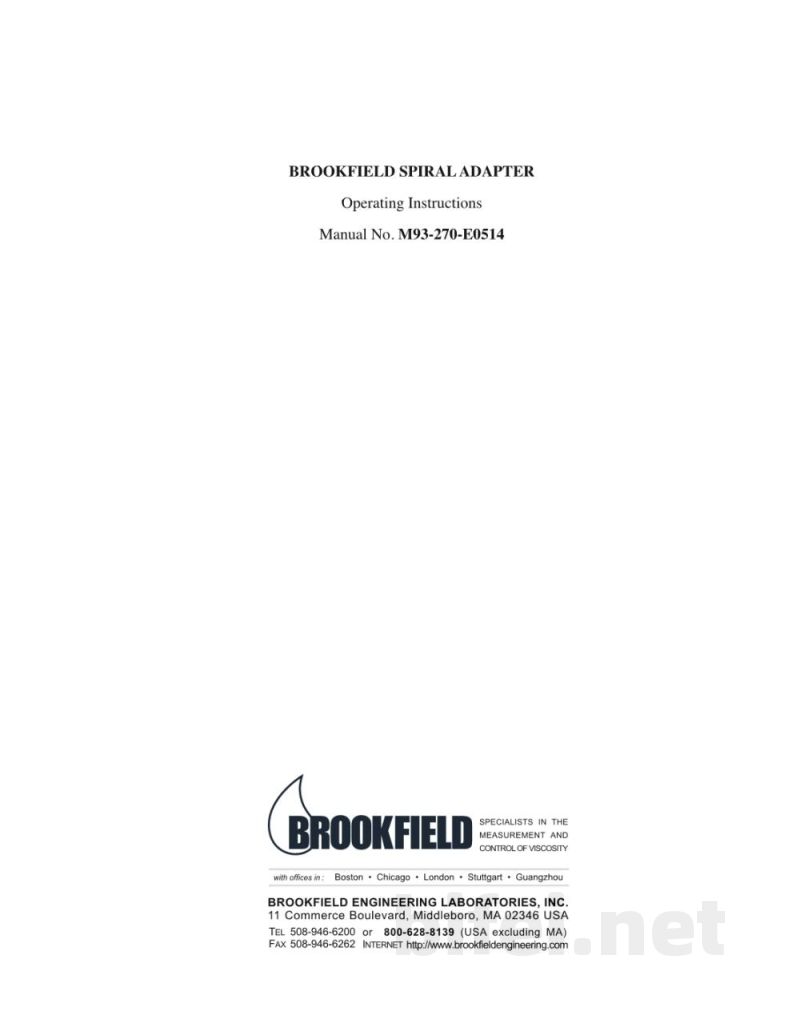
BROOKFIELD SPIRAL ADAPTER
Operating Instructions
Manual No. M93-270-E0514
With offices in: Boston · Chicago · London · Stuttgart · Guangzhou
Specialists in the measurement and control of viscosity
Contact: 11 Commerce Boulevard, Middleboro, MA 02346 USA
Tel: 508-946-6200 / 800-628-8139 (USA excluding MA)
Fax: 508-946-6262
Website: http://brookfieldengineering.com
TABLE OF CONTENTS
I. Introduction
II. Components
III. Specifications for Test Set Up
IV. Installation
V. Operation
V.1 Theory
V.2 Test Procedure
V.3 Data Gathering
V.4 Application Examples – Solder Paste
V.5 Cleaning the Spiral Adapter
Appendix A – Spiral Spindle Factors for Torque Measurements
Appendix B – Online Help and Additional Resources
Appendix C – Warranty Repair and Service
INTRODUCTION
When used with any standard Brookfield Viscometer/Rheometer, the Spiral Adapter can measure fluid viscosity at various shear rates. Viscosity is a measure of a fluid's resistance to flow. A detailed description of the mathematics of viscosity is available in Brookfield publication “More Solutions to Sticky Problems”, provided with the Viscometer/Rheometer and also available as a PDF on the Brookfield website.
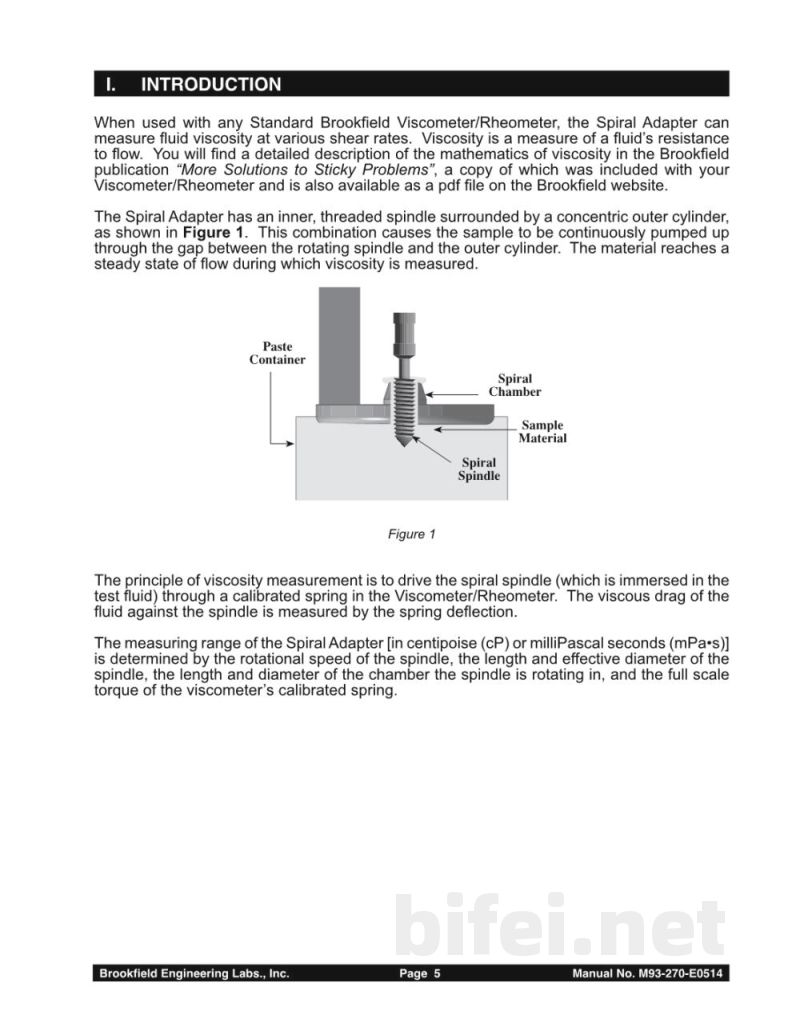
The Spiral Adapter has an inner threaded spindle surrounded by a concentric outer cylinder. This structure causes the sample to be continuously pumped upward through the gap between the rotating spindle and the outer cylinder. The material reaches a steady state of flow during which viscosity is measured.
The principle of viscosity measurement is to drive the spiral spindle, immersed in the test fluid, through a calibrated spring in the viscometer/rheometer. The viscous drag of the fluid against the spindle is measured by spring deflection. The measuring range of the Spiral Adapter (in centipoise cP or millipascal seconds mPa·s) depends on spindle rotational speed, spindle geometry, chamber dimensions, and full-scale torque of the viscometer.
Operating Instructions
Manual No. M93-270-E0514
With offices in: Boston · Chicago · London · Stuttgart · Guangzhou
Specialists in the measurement and control of viscosity
Contact: 11 Commerce Boulevard, Middleboro, MA 02346 USA
Tel: 508-946-6200 / 800-628-8139 (USA excluding MA)
Fax: 508-946-6262
Website: http://brookfieldengineering.com
TABLE OF CONTENTS
I. Introduction
II. Components
III. Specifications for Test Set Up
IV. Installation
V. Operation
V.1 Theory
V.2 Test Procedure
V.3 Data Gathering
V.4 Application Examples – Solder Paste
V.5 Cleaning the Spiral Adapter
Appendix A – Spiral Spindle Factors for Torque Measurements
Appendix B – Online Help and Additional Resources
Appendix C – Warranty Repair and Service
INTRODUCTION
When used with any standard Brookfield Viscometer/Rheometer, the Spiral Adapter can measure fluid viscosity at various shear rates. Viscosity is a measure of a fluid's resistance to flow. A detailed description of the mathematics of viscosity is available in Brookfield publication “More Solutions to Sticky Problems”, provided with the Viscometer/Rheometer and also available as a PDF on the Brookfield website.
The Spiral Adapter has an inner threaded spindle surrounded by a concentric outer cylinder. This structure causes the sample to be continuously pumped upward through the gap between the rotating spindle and the outer cylinder. The material reaches a steady state of flow during which viscosity is measured.
The principle of viscosity measurement is to drive the spiral spindle, immersed in the test fluid, through a calibrated spring in the viscometer/rheometer. The viscous drag of the fluid against the spindle is measured by spring deflection. The measuring range of the Spiral Adapter (in centipoise cP or millipascal seconds mPa·s) depends on spindle rotational speed, spindle geometry, chamber dimensions, and full-scale torque of the viscometer.
预览图片
第1页

第2页
第3页

第4页
第5页